
Southern Serengeti Migration Guide
When the southern Serengeti plains and Ndutu make sense for the Great Migration — the green-season calving window, the predators it draws, and how to plan a mobile-camp safari around the herds. An honest, evergreen guide to migration timing in the south.

Photo: Helena Pfisterer / Unsplash
- ✓The southern plains hold the migration in the green months — roughly December to March — when the herds gather to graze and calve.
- ✓This is the calving chapter of the loop, peaking around February, not the river-crossing chapter — different drama, no crocodiles.
- ✓The herds' presence brings the most intense predator action of the year on open, treeless ground.
- ✓Mobile camps that follow the herds, focused on the Ndutu area, are the natural way to be close to the action.
- ✓Treat all timing as a 30-year average — the herds follow the rains, not a calendar, so verify your exact dates and never expect a guaranteed spectacle.
The southern chapter of the loop
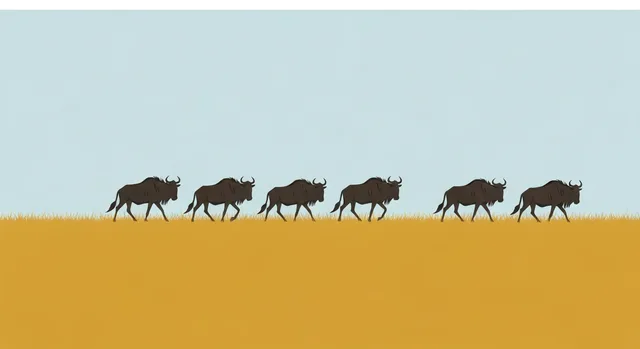
The Great Migration is a year-round clockwise loop through the Serengeti–Mara ecosystem, not a single scheduled event — the roughly 1.5 million wildebeest, joined by hundreds of thousands of zebra, are always somewhere. The southern plains are where that loop pauses and turns: this is the calving country, the place the herds gather in the green months to give birth before beginning their long march north and west. If the Mara crossings are the migration's most famous chapter, calving on the southern plains is its origin story.
Understanding the south's role is the key to planning around it. The herds come here for the grass: the southern short-grass plains, blanketed in mineral-rich volcanic ash from the Ngorongoro highlands, are the best grazing in the ecosystem and the ideal nursery. They arrive with the short rains, calve in the heart of the wet season, and leave as the plains dry. Time your visit to that window and you stand inside one of the great wildlife events on earth; miss it, and the south is a beautiful but largely empty plain.
This page is about the migration specifically — when the south makes sense, what it offers and how to plan a trip around the herds. For the landscape and the wider experience of the southern plains in any season, see the southern plains guide.
When the herds are in the south
In a normal year, the migration is on the southern plains from around December to March. The short rains, breaking from around November, green the southern grass and pull the herds down from the central and western Serengeti. Through December and January they spread across the plains around the Ndutu area to graze, building condition for the births to come. The peak — the reason so many travellers target these months — is calving, which usually centres on February.
From around March and into the long rains of April and May, the picture begins to change. The herds calve, the calves grow strong enough to travel, and as the southern plains start to dry the great mass begins to move north and west in search of fresh grazing — towards the Western Corridor and the Grumeti, and eventually the far north and the Mara. By the dry season, roughly June to October, the south is largely empty of the migration, which is then in the centre, west or north.
Every one of those windows is a long-term average, not a promise. The migration follows the rains, and the rains vary: an early or late, strong or weak wet season shifts the timing by weeks and moves the herds with it. No chart, including this one, can tell you exactly where the herds will be on a given future date. The practical rule is to plan for the south in the green months, build in a few days' flexibility, and verify the likely picture for your specific dates close to travel.
- December–January: herds gather on the southern plains as the short rains green the grass.
- Around February: peak calving — the densest concentration the south ever holds.
- March–May: calves strengthen; the herds begin moving north and west as the plains dry.
- June–October: the migration has left the south for the centre, west and north.
Calving, not crossings: a different kind of drama
It is worth being clear about what the southern migration is — and is not. This is the calving chapter, not the river-crossing chapter. There are no Mara River crossings in the south; the crocodile-dark water and the churning gambles on the banks belong to the far north around Kogatende, in the dry season. The drama here is of a different order: the sheer scale of birth, with somewhere near half a million calves arriving in a window of about three weeks, and the relentless predator pressure that follows them.
That predator pressure is the south's signature. The open, treeless plains give the herds early warning and let cheetahs hunt in the clear, while lions and hyenas work the edges of the calving grounds. Calving season is statistically the most intense predator viewing of the Serengeti year — the single best window to watch a cheetah run down prey across open ground. For travellers torn between the south and the north, the choice is really between two spectacles: newborn life and big-cat hunting in the green-season south, or the river gauntlet in the dry-season north.
- Southern migration = calving and open-plains predators; no river crossings.
- River crossings belong to the far north (Kogatende), in the dry season.
- Calving brings the year's most concentrated big-cat action.
- Open ground makes the south the best place to watch cheetahs hunt.
Planning a southern migration safari
Because the herds are here only seasonally, the natural way to be close to the southern migration is a mobile or seasonal camp that sets up on the plains for the green months and moves with the action. These tented camps position themselves near the calving grounds during the peak window and shift as the herds do, putting you closer to the day's wildlife than any fixed lodge could. For a calving-season trip, a well-placed mobile camp is the classic choice, and the Ndutu area is the established base for it.
Ndutu sits at the heart of the calving grounds, on the southern edge of the ecosystem where the Serengeti meets the Ngorongoro Conservation Area. That location is a planning advantage in two ways: it is right where the herds calve, and it combines naturally with the Ngorongoro Crater, which lies on the route in from Arusha. A green-season itinerary might pair the Crater with several Ndutu-area nights for the calving and the open-plains predators. Note that part of the Ndutu area lies within the Ngorongoro Conservation Area rather than Serengeti National Park, which carries its own rules and fees — verify the detail when planning.
Two honest caveats close the plan. First, the migration cannot be scheduled or guaranteed — give yourself several nights in the south during the window and travel with a patient guide rather than chasing a single day. Second, rates and park and conservation fees change, so do not anchor to fixed figures; verify current numbers with operators and official TANAPA and Ngorongoro sources close to travel. Plan for the green months, build in flexibility, and let the plains surprise you.
Related guides

Southern Serengeti Plains Guide
The southern Serengeti plains are the open, treeless short-grass country on the Ngorongoro edge — the migration's calving grounds and the park's most cinematic emptiness. A guide to planning the southern plains: the seasonal herds, calving, the predators that follow, mobile camps and Ndutu-adjacent safari days.
Read guide
Calving Season in the Serengeti (Ndutu)
Calving season on the southern Serengeti plains around Ndutu — when roughly half a million wildebeest are born in about three weeks, why it draws the densest predator action of the year, and how to plan a green-season safari around it.
Read guide
Mobile Camps in the Serengeti
How seasonal mobile camps follow the migration around the Serengeti, what staying in one is really like, and who should choose canvas-that-moves over a permanent lodge.
Read guideMore in Park Areas
6
Best Serengeti Area for a First Safari
A first-timer's decision guide to the Serengeti's sectors — central Seronera, the southern plains, the Western Corridor and the far north — chosen by month, budget and what you most want to see, with the honest trade-offs.
Read guide
Eastern Serengeti Guide
A guide to the eastern Serengeti — the wide-open, kopje-dotted plains east of Seronera, why they are some of the best cheetah country in the park, the low vehicle density that defines them, and when the eastern side is worth it.
Read guide
Grumeti: The Western Serengeti's River Country
A guide to Grumeti — the river, the wildlife and the exclusive private concessions on the Serengeti's western edge. Migration timing in the western ecosystem, giant crocodiles, and the luxury camps that draw travellers to this quiet corner.
Read guide
Ikoma & Fort Ikoma: Edge-of-Park Value in the Western Serengeti
A guide to the Ikoma area and Fort Ikoma on the western edge of the Serengeti — gateway to the Western Corridor, with drive-in access, budget-friendly stays in the Ikoma Wildlife Management Area, night-drive options and honest caveats.
Read guide
Moru Kopjes Guide
A guide to the Moru Kopjes in the central-southern Serengeti — the dramatic granite outcrops famous for lions and rock art, one of the park's last rhino strongholds, and how Moru fits a central-southern game drive.
Read guide
Namiri Plains Guide
A guide to Namiri Plains in the eastern Serengeti — the open, kopje-dotted cheetah country east of Seronera, why it is one of Africa's great predator landscapes, how camps are positioned, and who should go east.
Read guide