
 Wildlife
Serengeti Wildlife Guide
What wildlife you can realistically expect to see in the Serengeti and where — the Big Five, the big cats, the other predators, the migrating herds, plains game and birds — read by sector and season, with honest, no-guarantee expectations.

- ✓The Serengeti holds all of the Big Five, with exceptional populations of lion, cheetah and leopard.
- ✓Central Seronera's rivers and kopjes are the most reliable year-round bet for big cats, especially leopard.
- ✓What you see is set by where and when you go — the herds move, so the odds shift through the year.
- ✓Black rhino survive only in small, protected pockets; they are the hardest of the Big Five to find.
- ✓Wildlife is wild — sightings are never guaranteed, and a good guide matters more than a long checklist.
What you can realistically expect to see
The Serengeti is one of the great wildlife stages on earth, but the honest framing is probabilities, not promises. Over a few days in the right sector you can reasonably expect lions, elephants, giraffes, buffalo, hippos and a vast supporting cast of plains game; leopard and cheetah are likely with patience and a good guide; black rhino and wild dog are the rare prizes that some trips miss entirely. The single most useful planning truth is that what you see is shaped less by luck than by where you go and when — this guide ties each animal to the sectors and seasons that give you the best odds.
It pays to come with the right expectations. The drama people picture — a river crossing, a cheetah hunt, a leopard hauling a kill into a fig tree — is real but cannot be scheduled, and the joy of a safari is as much in the patient hours of plains game and birdsong as in the headline moments. Treat every 'best place to see X' as an average, not a guarantee, lean on your guide's local knowledge, and let the ecosystem surprise you.
The Big Five, and the honest odds on each
The Big Five — lion, leopard, elephant, buffalo and rhino — is an old hunting term, not an ecological one, but it remains a useful checklist because the five animals sit at very different ends of the difficulty scale. Four of them are realistic on a well-planned Serengeti trip; the fifth, the rhino, is genuinely hard. Knowing which is which keeps the trip honest and stops a missed rhino from overshadowing a superb safari.
Lions are widespread and often easy; elephants and buffalo are common in the right country; leopards take patience and the central river valleys; black rhino cling on only in a few protected pockets such as the Moru Kopjes and are the hardest sighting in the park. Build the trip around the four you can reasonably expect, and treat rhino as a bonus rather than a target.
- Lion — common and widespread; the most reliable of the five, especially around Seronera's kopjes.
- Elephant — common in wooded and riverine country; large, easy herds in the central and northern sectors.
- Buffalo — common, often in big herds near water; one of the easier of the five.
- Leopard — present but secretive; the Seronera river figs are the classic place to look, with patience.
- Black rhino — rare and protected; a few pockets only, the Moru Kopjes among the best chances.
The big cats — lion, leopard and cheetah
The cats are why most people come, and the Serengeti is one of the best places on earth to see all three. Lions are the headline: the ecosystem holds one of the largest populations in Africa, and the central kopjes are famous for prides lounging on the warm granite. Leopards are the patient traveller's reward, most reliably found draped in the riverine fig trees of the Seronera valley. Cheetahs favour open ground, hunting in the clear on the southern short-grass plains — never more so than during the calving season, when prey is concentrated.
Where you go tilts the odds. Central Seronera is the year-round stronghold for lion and leopard; the open south is cheetah country, especially from December to March; and the far north adds lions hunting along the herds' crossing routes in the dry season. A good guide reading fresh tracks and alarm calls will do more for your cat sightings than any single 'best' location.
- Lion — densest around Seronera's kopjes and rivers; reliable in every month.
- Leopard — secretive; the Seronera fig trees are the classic spot, best early and late in the day.
- Cheetah — open southern plains, especially during the calving season's concentrated prey.
Predators beyond the cats
The cats get the billing, but the Serengeti's predator guild is far richer. Spotted hyenas are everywhere and are accomplished hunters in their own right, not merely scavengers; their nightly whoops are one of the defining sounds of a safari camp. Black-backed and golden jackals work the plains, and the rare African wild dog — wiped out of the park for years and now seen again at its edges — is one of the most prized and unpredictable sightings of all.
Predator action is the heart of the drama, and it follows the prey: where the herds gather, the hunters concentrate. The calving season on the southern plains brings the year's most intense viewing, but a kill or a chase can happen anywhere, at any hour, which is why early starts and patient waiting pay off so well.
The herds, plains game and the supporting cast
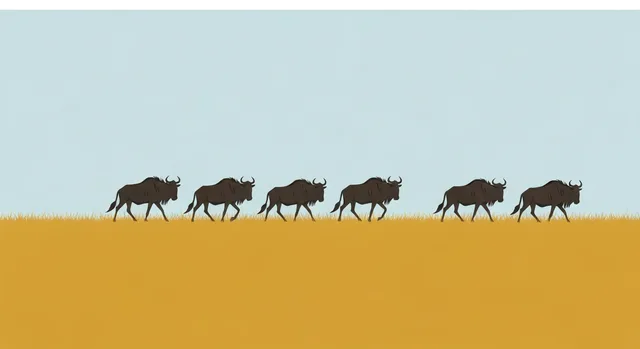
The Great Migration — roughly 1.5 million wildebeest with hundreds of thousands of zebra and gazelle — is the ecosystem's beating engine, and even outside the headline river crossings the sheer mass of grazing animals is a spectacle in itself. The herds shape everything else, drawing the predators and fertilising the plains as they move, so understanding their rhythm is central to reading the wildlife.
Around and beyond the herds is a deep supporting cast that rewards every drive: towering Maasai giraffe, elephant families at the waterholes, big buffalo herds, hippos crowding the rivers and pools, plus topi, hartebeest, eland, impala, warthog and more. These animals are present year-round across most sectors, so even a trip that misses the migration's drama is full of life.
- Wildebeest & zebra — the migrating millions; present somewhere in the ecosystem all year.
- Giraffe, elephant & buffalo — large, reliable and widespread in the right country.
- Hippo — crowded in rivers and pools; the Retina and Seronera hippo pools are classics.
- Plains game — topi, hartebeest, eland, impala, gazelle and warthog fill every drive.
Birds, raptors and the smaller Serengeti
It is easy to arrive fixated on big game and leave a convert to the birds. The Serengeti and its wetlands hold well over 500 recorded species, from ostrich, secretary bird and kori bustard striding the plains to lilac-breasted rollers, bee-eaters and a constant traffic of raptors overhead — eagles, vultures and harriers that are themselves part of the predator story. The green season, roughly November to April, brings migrants and breeding plumage and is the richest time for birding.
The smaller Serengeti rewards a slow eye: mongoose and hyrax around the kopjes, agama lizards on the warm rock, dung beetles at work on the plains, and the night shift of bushbabies, genets and owls that a good night drive or a quiet evening in camp can reveal. Telling your guide you care about birds and the small stuff changes the trip — they will slow down and show you a different, deeper park.
When and where the odds are best
Because the migration moves and the resident game does not, the best plan matches your animal to your month and your sector. For dependable big cats and resident game in any month, base in central Seronera. For calving and concentrated predator action, come to the southern Ndutu plains from roughly December to March. For the famous Mara River crossings, the far north around Kogatende delivers from about July to October. Treat all of these as long-run averages — the herds answer to the rain, not the calendar — and confirm the live picture before booking a camp.
The wildlife calendar pulls this together month by month, and the areas guide maps it onto the ground. Read them side by side: pick the chapter of the story you want, find the sector that holds it for your dates, and choose a camp inside that area. Get the season-and-sector decision right first, and the sightings largely follow.
- Year-round big cats & resident game: central Seronera.
- Calving & predator action: southern Ndutu plains, roughly December to March.
- Mara River crossings: far north / Kogatende, roughly July to October.
- All timing is a 30-year average — verify the live position before you book.
Seeing it well — guide, etiquette and the camera
The biggest variable in what you see is not the season or the sector but the person at the wheel. A sharp guide reads tracks, alarm calls and the behaviour of other animals, knows where a leopard rested yesterday, and positions the vehicle for the light and the moment. Brief your guide on what matters to you — cats, birds, photography, unhurried time — and you will get a sharper, more rewarding trip than any itinerary can promise on its own.
How you watch matters too. Keeping a respectful distance, staying quiet at a sighting, never surrounding or pressuring an animal, and resisting the urge to chase the next radio call all make for better, calmer wildlife — and better viewing. If you are bringing a camera, the right gear and a little preparation turn fleeting moments into keepers without getting in the way of simply being there.
At a glance
The essentials of Serengeti wildlife. Which animals are easy and which are hard, and the season-and-sector logic, are evergreen; exact migration timing, park fees and access change, so confirm the live picture and the official rules before you travel.
- Reliable: lion, elephant, buffalo, giraffe, hippo, zebra, wildebeest and plains game.
- Likely with patience: leopard and cheetah, best in their core sectors and seasons.
- Rare prizes: black rhino and wild dog — treat as a bonus, not a target.
- Birds: 500-plus species, richest in the green season (roughly November to April).
- Best odds = right sector for your month; all migration timing is a long-run average.
- A good guide and respectful viewing matter more than any single 'best' location.