Best Months for Serengeti Photography
Which Serengeti months deliver the photographs you want — dramatic light and dust, emerald plains, newborns, river crossings, big cats and fewer vehicles in your frame.

- ✓There is no single best month for Serengeti photography — there is a best month for the image you most want to make.
- ✓February gives you newborns and the densest predator action on open plains; the dry season (June–October) gives you dust, drama and the Mara crossings.
- ✓The green low season (April–May, November) trades easy game for emerald backdrops, storm light and the fewest vehicles in your frame.
- ✓Light is everything: the golden hours after dawn and before dusk do most of the work, and a balloon flight buys a completely different aerial perspective.
- ✓Treat all migration timing as a 30-year average and verify herd position and conditions for your exact dates — the herds follow the rains, not the calendar.
Photograph the moment, not the month
The most useful question a Serengeti photographer can ask is not 'when is the best month?' but 'what is the picture I am travelling for?' The park offers radically different images depending on the season — a dust-wreathed wildebeest plunge into a crocodile river, a cheetah at full stretch on open green grass, a newborn calf wobbling under a stormy sky, a leopard draped in a Seronera fig at golden hour. Each lives in its own window of the year.
Decide on the hero shot first, then let the calendar follow. This page walks the months as an ordered set, from the calving drama of late summer to the dust and crossings of the dry season to the cinematic quiet of the green months. Wherever you land, two truths hold: the golden hours do most of the heavy lifting, and the resident big cats of central Seronera are photogenic in every single month.
It also helps to be honest with yourself about how you like to shoot. If you crave action and the adrenaline of an unfolding hunt or crossing, you will plan very differently from someone who wants painterly landscapes and contemplative portraits. The Serengeti can serve both, but not always in the same week or the same sector — so the clearer you are about your style, the more decisively the months below will choose themselves.
January to March: calving, cheetahs and open plains
If your dream frame is a predator in action, the calving window on the southern Ndutu plains is hard to beat. Calving peaks around February, when roughly half a million wildebeest are born on short-grass country in a span of about three weeks. The plains are open and largely treeless, which is a gift to a photographer: cheetahs hunt in the clear, lions work the herds in full view, and there is nowhere for the action to hide.
The light in these months is warm and the plains are green from early rains, so you get drama without dust. Long lenses earn their keep here, but so does a wider frame that places a tiny calf against the vast plain. The trade-off is that this is a popular window, so good vehicle positioning and an early start matter. March stretches the season's tail with thinning crowds.
- Best for: cheetah and lion action, newborn calves, low-angle plains compositions.
- Look: warm light, green short grass, open treeless backdrops, minimal dust.
- Watch for: popular dates — get out at first light for clean positioning.

April and May: emerald plains and storm light
The long rains turn the Serengeti into the greenest, most cinematic version of itself, and they hand photographers two things money cannot otherwise buy: extraordinary storm light and almost empty plains. Towering cloud banks, shafts of sun breaking through, and a lone acacia silhouetted against the weather are the signature green-season images. With the fewest vehicles of the year, you can compose without a single other car in the frame.
The honest trade is that game is more spread out and some tracks run heavy, so you work a little harder for each subject. But for landscape, mood and atmosphere — and for cat portraits set against deep green rather than dust — these months are unmatched. Bring rain protection for your gear, embrace the dramatic skies, and treat the afternoon storms as a feature rather than a problem.
- Best for: moody landscapes, storm light, green-backdrop wildlife portraits.
- Look: saturated greens, dramatic skies, soft diffused light between showers.
- Watch for: heavy tracks and spread-out game — weatherproof your kit.

June to October: dust, drama and the river crossings
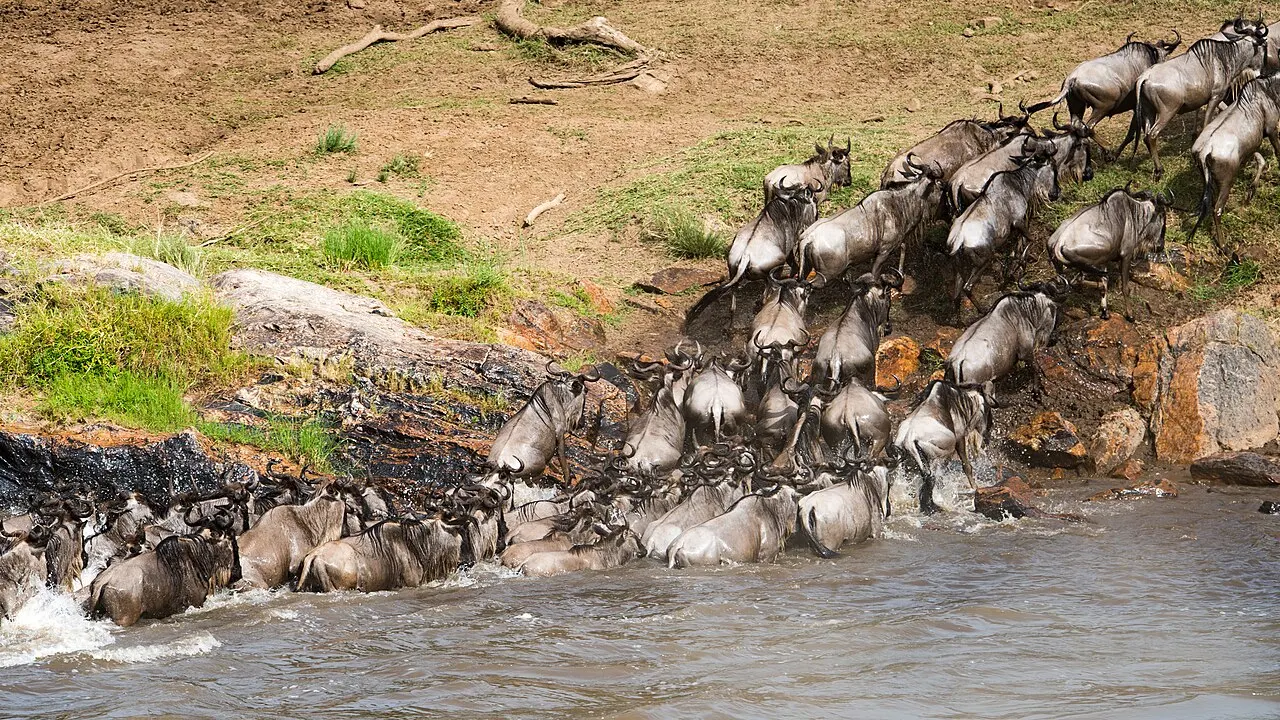
The dry season is the Serengeti's blockbuster for a reason. The bush thins, animals concentrate around shrinking water, and the air fills with golden dust that turns every backlit herd into a painting. From about July the migration reaches the Mara River in the far north, and the river crossings — wildebeest pouring down crocodile-dark banks in a churning rush — are the single most cinematic hour the park offers. Peak crossing drama is usually August, lingering into September and October.
For the crossing photographer, the rules are patience and position: base yourself in the north for several nights during the window, work with a guide who finds good angles without crowding the banks, and accept that a crossing can happen at dawn or not at all. Beyond the river, the whole park photographs beautifully now — dust halos, dramatic light, big cats on dry kopjes. The cost is the year's busiest, priciest conditions and more vehicles competing for the same shot.
- Best for: Mara River crossings, backlit dusty herds, classic dry-season wildlife.
- Look: golden dust, hard clear light, animals concentrated at water.
- Watch for: crowds at crossings and premium rates — book the north far ahead.
November and the green return
When the short rains break around November, the plains green up within days and the migration swings back south. It is an underrated photographic window: the dust settles, the light softens, migratory birds arrive in breeding colour, and the crowds thin markedly. You get fresh green backdrops without the full commitment of the long rains, and birding photography is at its very best.
The unpredictability of the short rains is part of the appeal — scattered showers mean fast-changing light and dramatic, ever-shifting skies. For a photographer who values atmosphere and solitude over guaranteed concentrations of game, late in the year can deliver frames no peak-season trip ever will.
It is also a forgiving month for learning the park's light. With the herds moving and the rains keeping things fresh, you get a little of everything — open plains, gathering storms, golden mornings — without committing to a single extreme. If you can only travel once and want variety in the bag, November is a quietly clever choice, provided you go in ready to chase the weather rather than fight it.

Matching the sector to the shot
Month chooses your season; sector chooses your subject. Central Seronera, with its rivers, granite kopjes and riverine figs, is the year-round home of the cat portrait — leopards in the trees, lions on the rocks at golden hour, cheetahs on the fringing plains. If big-cat photography is your core ambition, you can anchor here in almost any month and let the light do the rest.
The southern Ndutu plains are calving and open-plain country — the place for action sequences, low-angle compositions and predator-and-prey drama against a clean horizon. The Western Corridor and Grumeti offer the migration's first water crossings and a different, more wooded backdrop. And the far north at Kogatende is crossing country: the only place to make the Mara River images, and only really in the dry-season window. Build your route so the sector you spend most nights in matches the photograph you most want to bring home, and verify the herds' likely position for your dates before you commit.
Light, lenses and getting the most from any month
Whatever month you choose, the golden hours after sunrise and before sunset do the real work — plan your drives around them and treat the harsh midday for travel, scouting or rest. A dawn balloon flight over the plains is the classic way to buy an entirely different perspective: the herds as patterns on the land, shadows stretched long, the curve of the ecosystem laid out beneath you. It is the one splurge most photographers never regret.
Practically, bring a long lens for the cats and crossings and a wide one for the storm-and-plains compositions, plus a beanbag for steadying shots from the vehicle. Dust protection matters in the dry months; rain protection matters in the green ones. And whatever the calendar promises, verify the likely herd position and current conditions for your exact dates before you commit — the Serengeti follows the rains, and the best photographers travel ready to follow them too.
Related guides

Serengeti Photography Safari
How to plan a photo-first Serengeti safari — the vehicle and private guide that make or break your images, the lenses and light to plan for, and the seasons that put predators and crossings in front of your lens.
Read guide
Serengeti Photography Itinerary
A photo-first Serengeti itinerary built around a private vehicle, the golden hours, predator action, the river crossings and camp position — the route that puts you in the right light, in the right sector, with the time to wait for the shot.
Read guide
Mara River Crossings in the Serengeti
How to plan a Northern Serengeti river-crossing safari without false promises — when the Mara crossings happen at Kogatende, why timing is luck, where to stay, and how to watch with good wildlife etiquette.
Read guideMore in When to Go
6
Calving Season in the Serengeti
Calving season on the southern Serengeti plains around Ndutu — when roughly half a million wildebeest are born in about three weeks, why it draws the densest predator action of the year, and how to plan a green-season safari around it.
Read guide
Calving Season in the Serengeti (Ndutu)
Calving season on the southern Serengeti plains around Ndutu — when roughly half a million wildebeest are born in about three weeks, why it draws the densest predator action of the year, and how to plan a green-season safari around it.
Read guide
Calving Season vs River Crossings
Two faces of the Great Migration: the southern Ndutu calving in the green months, and the northern Mara crossings in the dry. Decide between them by wildlife, budget, crowds, predictability and the kind of drama you want.
Read guide
Christmas & New Year in the Serengeti
How to plan a Christmas or New Year safari in the Serengeti — green December plains, gathering herds, premium festive camps, family-friendly logistics and the flights that make a holiday trip work. Romantic, festive and worth booking early.
Read guide
Great Migration Planning Mistakes
The planning mistakes that make travellers miss the herds, overspend, or book the wrong Serengeti sector — and how to avoid each one so your dates, your camp and the migration actually line up.
Read guide
How to Choose a Migration Camp
Match a Serengeti camp to your month, the migration phase, the nearest airstrip, your budget and your wildlife goal — so you sleep where the herds will be, not where the brochure photo was taken.
Read guide