
Serengeti Migration Safari Itinerary
A Serengeti migration safari itinerary that changes by month — from the Ndutu calving plains in the south, through the Grumeti in the west, to the Mara River crossings in the north — built on 30-year averages you verify for your exact dates.

Photo: Dawn Westveld / Unsplash
- ✓There is no single migration itinerary — the right route changes by month as the herds loop clockwise through the ecosystem.
- ✓South for calving (around Ndutu), west for the first crossings (the Grumeti), north for the Mara River crossings: pick the chapter you want to see.
- ✓Camp placement is the whole game — base in the sector where the herds usually are for your dates, ideally in a camp that moves with them.
- ✓The migration follows the rains, not a calendar; treat every timing as a 30-year average, keep a backup sector, and verify the live picture.
- ✓Give it time and use light-aircraft hops between sectors — patience and placement, not luck alone, put you in the action.
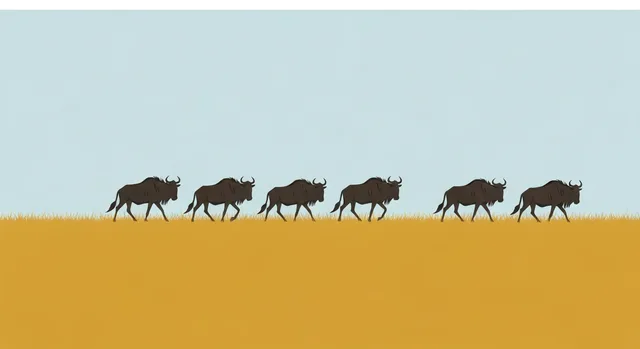
There is no single migration itinerary
The most important thing to understand before planning a migration safari is that there is no fixed itinerary to follow — only a season to match. The Great Migration is not a single scheduled event but a year-round clockwise loop: roughly 1.5 million wildebeest, with zebra and gazelle alongside, moving through the Serengeti–Mara ecosystem in pursuit of fresh grazing and the rains. The herds are always somewhere. The question that shapes your entire trip is which chapter of the story you want to stand inside, because that decides which sector you base in, which camp you choose, and even whether you drive or fly.
Decide the event first, then build the route around it. If you dream of newborn calves and the densest predator action of the year, you want the southern short-grass plains around Ndutu in the calving window. If you want the migration's first dramatic water test, you follow the Grumeti River in the Western Corridor. And if it is the iconic Mara River crossings you picture — columns of wildebeest pouring across crocodile-dark water — you head for the far north around Kogatende in the dry season. Each is a genuinely different trip, in a different part of a vast, 14,750-square-kilometre park, at a different time of year.
Frame your expectations honestly and the migration rarely disappoints. No ethical operator can schedule a river crossing or guarantee a calving stampede — these hinge on weather, grazing and the herds' collective nerve. We treat every timing on this page as a 30-year average, and a two-week swing in either direction is completely normal. The job of a good itinerary is not to promise the spectacle but to maximise your odds: the right sector for your month, a camp placed for the herds, enough time to be patient, and the flexibility to follow the migration when it shifts. Verify the live picture with your operator before you commit.
The migration itinerary at a glance
Before the seasonal routes, here is the orientation that applies in any month. Treat the migration timing as a 30-year average and verify the live picture with your operator before you commit to a camp or sector.
- Calving (roughly Jan–Mar): base south, around the Ndutu short-grass plains.
- First crossings (roughly May–Jul): follow the Grumeti River in the Western Corridor.
- Mara crossings (roughly Jul–Oct): base north, around Kogatende, and fly in.
- Camp strategy: a mobile camp that follows the herds, or a fixed camp chosen for your exact month.
- Length: a few days can catch one chapter; a week lets you base properly and wait out the action.
- Access: light-aircraft hops between Seronera, Ndutu and Kogatende airstrips.
- Always keep a backup sector — the herds can be early, late or scattered.
- Verify: park fees, camp rates and herd position all change — confirm before booking.

Calving season: the southern plains (roughly January–March)
The southern chapter is calving season, and it bases you on the short-grass plains around Ndutu on the Ngorongoro edge. These plains are some of the richest grazing in Africa, fed by volcanic ash from the highlands, and the herds gather here to give birth because the open, treeless ground lets them see predators coming and the new grass fuels lactating mothers. On the 30-year average, calving peaks in February, and in a window of roughly three weeks around half a million calves arrive — the most concentrated burst of new life in the natural world.
For the itinerary, this means a southern or Ndutu-leaning base, ideally a mobile camp that can follow the herds across the plains as they shift with the rain. Calving season is the year's most intense predator viewing: lions, cheetahs and hyenas follow the food, and the open ground makes this the best window for watching a cheetah hunt in the clear. A typical southern route pairs several nights on the calving plains with a central Seronera leg for resident big cats and a change of landscape, giving range without long transit.
Build in flexibility. Calving is concentrated but mobile — the exact spot moves week to week across the southern plains — so a camp that travels with the herds and an operator who can adjust beat any fixed lodge locked to one view. Verify the live calving picture for your dates; it is an average, not a timetable.
The Grumeti: the western corridor (roughly May–July)
As the southern plains dry out, the herds turn west and north toward the Grumeti River in the Western Corridor — the migration's first great water test of the year. A western-leaning itinerary follows this chapter: the herds massing along the Grumeti, where crocodile-haunted pools force the first dramatic crossings before the more famous Mara crossings further north. It is a quieter, less-trafficked window than the dry-season peak, and the corridor's riverine forest and open grassland make a handsome, varied landscape to base in.
A Grumeti route bases you in the Western Corridor for the river action, often with a central Seronera leg either side to cover the herds as they move through and to add reliable resident wildlife. This is a transitional season, so the herds can be strung out across a long stretch of country — a flexible itinerary and a guide who knows where the front of the migration sits are especially valuable. Frame the Grumeti crossings as a thrilling bonus rather than a guaranteed centrepiece; they are smaller and less predictable than the Mara's.
As ever, verify the timing. The westward shift depends on when the southern plains dry and the rains pull the herds onward, and that varies year to year around the 30-year average. Keep a backup sector in mind — if the herds are still south or already pushing north, your operator should be able to adjust the route.
Mara River crossings: the far north (roughly July–October)
The northern chapter is the one most people picture: the Mara River crossings around Kogatende, where columns of wildebeest pile up on the banks, hesitate, and then pour across crocodile-dark water in a churning rush — the single most cinematic hour in the Serengeti. From about July the leading edge of the herds reaches the river; peak drama is usually August on the 30-year average, with crossings continuing into September and October as the herds move back and forth across the Kenyan border. The far north is remote, which is exactly its appeal: in the dry season you can watch a crossing with only a handful of other vehicles.
A Mara-crossing itinerary bases you in the north for several nights — three or more dramatically improves your odds over a single rushed day. Getting there means a light-aircraft flight to the Kogatende airstrip rather than a long drive, so the northern route is the most fly-in-dependent of all. A typical northern trip pairs a crossing base with a central Seronera leg for reliable big cats and a different landscape, giving the itinerary balance.
Set expectations carefully: a crossing can happen at dawn or not at all on a given day, because the herds cross when they cross, and no operator can schedule one. The way to weight the odds in your favour is to base in the north for several nights during the window, travel with a patient guide, and accept that the waiting is part of the experience. Give the river time, and it usually rewards you.
Camp placement, flights and keeping a backup
Whatever season you choose, the decision that makes or breaks a migration itinerary is camp placement. A camp's location matters more than its luxury — the best lodge in the wrong sector misses the action entirely. You have two broad strategies. A mobile camp packs up and moves with the herds through the year, putting you closest to wherever the migration sits; it is the strongest play for a migration-focused trip. A fixed camp trades that movement for reliable comfort and works well if you choose it carefully for your exact month. The honest rule is the same for both: verify a camp's location against the migration for your precise dates before you book, because the herds move and not all camps follow.
Light aircraft are what make a migration itinerary practical. They link Arusha and Kilimanjaro with the park's bush airstrips — Seronera in the centre, Kogatende in the north, the southern strips near Ndutu — and let you hop between sectors in minutes rather than burning daylight on rough roads. This matters most for the remote north, which is impractical to reach by road on a short trip. Remember the strict light-aircraft baggage rules: soft duffels only, with firm weight caps. Build connections with margin, because missing a once-daily bush flight is costly.
Finally, plan for the uncertainty the migration guarantees. Always keep a backup sector in mind and choose an operator with the flexibility to move you toward the action if the herds are early, late or scattered — all normal swings around the 30-year average. Because park fees, camp rates and herd position all change, we keep figures off this page and point you to current sources instead. The travellers who leave happiest give the migration time, place their camps wisely, keep a plan B, and treat the headline moments as odds to be earned rather than promises to be cashed. Get that right, and a migration itinerary delivers the greatest wildlife spectacle on earth at its most thrilling.
How long you need, and how to match length to chapter
The length of a migration itinerary should follow the chapter you want to see, not a generic number. A few days can genuinely catch one chapter if you base directly in the right sector — three or four nights on the southern plains during calving, for instance, is enough to immerse yourself in the birthing pulse and the predators that follow, because the herds are concentrated and you are already among them. The Mara crossings demand more patience: a crossing can happen on any day or none, so the north rewards several nights, with three or more dramatically improving your odds over a single rushed day.
A week is the length at which a migration trip really comes into its own. Seven days lets you base properly in your season's sector, wait out the action, absorb a quiet day, and still add a contrasting central Seronera leg for resident big cats. If you have longer, the most rewarding use of extra days is almost always more nights in your migration sector — patience converts proximity into spectacle — rather than collecting more sectors. The migration is not a checklist of locations to visit; it is one event to be witnessed well, in one place, at the right time.
Whatever length you choose, the rule is the same: concentrate your time where the herds are for your dates, and keep the rest of the itinerary as supporting structure. A short trip should commit fully to one chapter; a longer trip can pair that chapter with reliable resident wildlife. The worst migration itineraries spread themselves thin across the whole ecosystem in a few days; the best go deep in the one sector that matters.
Setting expectations, and the wider rewards of a migration trip
The travellers who love their migration safari most are those who arrive with the right expectations. The migration is the greatest wildlife spectacle on earth, but it is a wild event, not a performance scheduled for your convenience. A river crossing may unfold at dawn in a churning, dust-and-water roar — or the herds may stand on the bank all day and never go. Calving may carpet the plains with newborns before your eyes, or be a few days early or late. No operator can promise the headline moment, and anyone who does is overselling. What a well-built itinerary promises instead is the best possible odds and the time to be patient.
And here is the reassuring truth: even when the headline moment is shy, a migration trip overflows with reward. The sheer scale of the herds — a horizon-filling river of animals, the constant grunting chorus, the dust rising over the plain — is a spectacle in itself, crossing or no crossing. The predators that shadow the migration deliver some of the finest big-cat viewing on the continent. And the landscape, whether the green calving plains of the south or the golden crossing country of the north, is among the most beautiful on earth. Come for the whole ecosystem in motion, not a single clip you have seen on a screen, and the migration almost never disappoints.
So plan deliberately, then let go. Decide your chapter, place your camps by position for your exact dates, give the trip enough time, keep a flexible backup, and verify the live picture with your operator before you commit. Then arrive ready to be patient and open to whatever the wild Serengeti offers, because that openness is what separates the travellers who leave thrilled from those who leave counting what they missed. A migration itinerary, built and approached this way, delivers a few days inside the oldest, grandest rhythm in nature — and that is a thing you carry home for the rest of your life.

Related guides

Where to Stay for the Migration
A sector-by-sector guide to where to sleep for the Great Migration — Ndutu for calving, the Western Corridor and Grumeti, central Seronera, and Kogatende in the north for the Mara crossings — matched to the month you travel.
Read guide
Calving Season in the Serengeti (Ndutu)
Calving season on the southern Serengeti plains around Ndutu — when roughly half a million wildebeest are born in about three weeks, why it draws the densest predator action of the year, and how to plan a green-season safari around it.
Read guide
Mara River Crossing Itinerary: Planning the Northern Serengeti for the Crossings
A Northern Serengeti itinerary built for the Mara River crossings — when to go, how many buffer nights to give yourself, Kogatende camps, fly-in strategy, the ethics of waiting, and why no operator can promise a crossing. Evergreen timing to verify.
Read guideMore in Itineraries
6
Budget Serengeti Itinerary
A realistic budget Serengeti itinerary built on group-joining safaris, camping and smart shoulder-season timing — where to save, where never to cut corners, and how to keep the magic without the luxury price tag.
Read guide
Family Serengeti Safari Itinerary
A family-paced Serengeti itinerary built around shorter drives, family-friendly camps with pools, easier logistics and real safety — the route that keeps both the children and the parents happy on an African safari.
Read guide
First-Time Serengeti Itinerary
The safest, most rewarding route for a first Serengeti safari — how to choose between central Seronera, the migration sectors, the Ngorongoro Crater and flying versus driving, without the rookie mistakes that ruin a first trip.
Read guide
Five-Day Serengeti Safari
A classic five-day Serengeti and Ngorongoro Crater route with better pacing, more wildlife diversity and sound camp logic — how to combine the central plains with the great caldera without rushing, by road or by air.
Read guide
Fly-In Serengeti Itinerary: A Time-Efficient Plan by Airstrip and Season
A time-efficient fly-in Serengeti itinerary — how to pick the right airstrip for your month, pair it with a camp and a migration target, link light-aircraft hops, pack for the weight limits, and a sample route. Evergreen timing to verify.
Read guide
Four-Day Serengeti Safari
A balanced four-day Serengeti safari: an arrival day, two full game-drive days in the central plains and a relaxed departure, with realistic flight-and-road logistics, honest pacing and the camp logic that makes a short trip feel unhurried.
Read guide