
Where to Stay for the Migration
A sector-by-sector guide to where to sleep for the Great Migration — Ndutu for calving, the Western Corridor and Grumeti, central Seronera, and Kogatende in the north for the Mara crossings — matched to the month you travel.

Photo: Dawn Westveld / Unsplash
- ✓There is no single migration lodge — the herds move clockwise through the ecosystem all year, so the right base is whichever sector they are likely to be in for your dates.
- ✓Calving (≈ December–March) points south to Ndutu; the first river drama (≈ May–July) points west to the Grumeti; the Mara crossings (≈ July–October) point north to Kogatende.
- ✓Central Seronera is the all-rounder: never far from the loop, strong on resident big cats, and an easy first base if your dates fall between the headline acts.
- ✓Mobile camps that relocate with the herds, and seasonal camps that open only in season, usually beat a fixed lodge for sheer proximity — but they book out furthest ahead.
- ✓Treat every month here as a 30-year average. A good camp is placed for the herds' likely position, never a guaranteed date — verify placement for your exact dates before you book.
Choose the sector before the camp
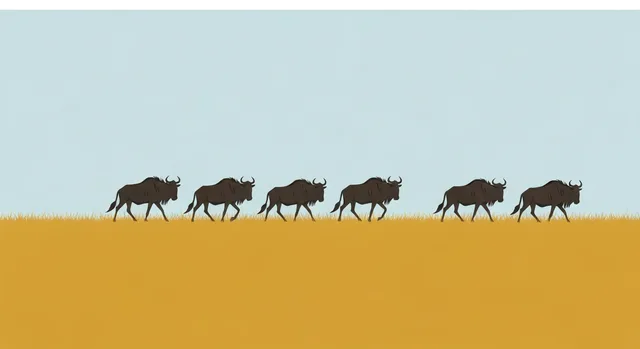
The most romantic mistake a first-time migration traveller can make is to fall for a camp's photographs and book it before checking where the herds will actually be. The Great Migration is not an event with a venue; it is a roughly clockwise loop of around 1.5 million wildebeest, plus hundreds of thousands of zebra and gazelle, moving through the Serengeti–Mara ecosystem in endless pursuit of new grass and water. Because the loop is driven by the rains rather than a calendar, the single decision that shapes a migration safari is not which lodge has the best beds — it is which sector the herds are likely to occupy on your dates, and whether your bed sits inside that sector.
Get the sector right and almost any comfortable base will reward you; get it wrong and the grandest suite in the park can be a three-hour drive from the action, eating the golden light at both ends of the day. So this guide is organised the way the decision should be made: first by the chapter of the migration you want to witness, then by the sector that chapter unfolds in, and only then by the style and comfort of the camps that sit there. Use it alongside the month-by-month tracker, decide which act you are travelling for, and let that fix your address.
One principle threads through everything below. No ethical operator can promise you a river crossing, a calving spectacle, or even that the herds will be exactly where the averages say. What a good camp can do is place you on the right stage at the right time, with patient guides and enough nights to let the wild unfold. That is the realistic, honest version of a 'migration lodge' — and it is plenty.
At a glance: which sector, which month
Use this as a fast orientation before the detail. Each row pairs a chapter of the migration with the sector to sleep in and the rough window it tends to fall in. Remember the windows are long-run averages — the rains can swing the herds a fortnight either way, so confirm placement for your exact dates.
- Calving on the short-grass plains: stay south, near Ndutu, roughly December–March (peak births around February).
- Herds drifting west and the first water test: stay in the Western Corridor / Grumeti, roughly May–July.
- The Mara River crossings: stay north, near Kogatende and Lamai, roughly July–October (often peaking around August).
- Between the headline acts, or an all-season base: stay central, around Seronera, where the loop is never far away.
- Want maximum proximity: a mobile camp that relocates, or a seasonal camp open only in season, usually beats a fixed lodge.
- Always: choose the sector by the herds' likely position first; weigh style, comfort and cost second; verify dates before booking.
South for calving: Ndutu and the short-grass plains
From roughly December to March the herds gather on the southern short-grass plains around Ndutu, on the Ngorongoro edge, to give birth. The grazing here is some of the richest in Africa — fed by mineral-laden volcanic ash from the highlands — and the open, near-treeless ground lets a wary wildebeest see a predator coming, which is exactly why the herds choose it as a nursery. In a window of only a few weeks, often peaking around February, something like half a million calves are born. Predators follow the food, so this is the most intense stretch of big-cat action in the Serengeti year, with cheetahs hunting in the clear across ground that hides nothing.
To sleep inside this chapter you want a base on or near the southern plains around Ndutu. Two things matter when you read camp marketing for this sector. First, Ndutu straddles a boundary: much of the calving action happens in the Ngorongoro Conservation Area rather than the national park proper, which carries its own permit logic and is one reason mobile and seasonal camps dominate here. Second, the plains are vast and shadeless, so camps tend to be lightweight and seasonal — pitched for the calving months and struck once the herds move on. That seasonality is a feature: a camp that exists only while the herds are calving is a camp built to be among them.
Lean towards a seasonal mobile camp here if proximity is your priority, and book early — the well-sited southern camps are limited and sell out furthest ahead. If you would rather trade a little proximity for solid comfort, some travellers base on the Ngorongoro side or in the southern-central transition and drive out to the calving grounds each morning. Either way, the honest framing holds: the births are a process, not a scheduled show, and the reward goes to those who give it unhurried time.
- Best window: roughly December–March, with calving usually peaking around February.
- Why here: richest short-grass grazing and open ground for a safe nursery — and the year's densest predator viewing.
- Camp style: mostly seasonal and mobile camps, placed for the calving months and struck afterwards.
- Watch the boundary: much of Ndutu sits in the Ngorongoro Conservation Area, with its own permit logic — verify with your operator.
West for the first river test: the Western Corridor and Grumeti
As the southern plains dry out, the herds begin their long drift west and north, and somewhere around May to July a great column funnels into the Western Corridor — the arm of the park that follows the Grumeti River towards Lake Victoria. This is the migration's first serious water obstacle, and while the Grumeti crossings are less famous and less reliable than the Mara drama up north, they carry their own tension: pods of large crocodiles wait in the river's dark pools, and the herds must gamble against them to reach fresh grazing. The corridor itself is a different Serengeti — riverine forest, denser bush and a softer, greener feel than the open plains.
Staying in the Western Corridor in this window puts you near the first act of the river story and rewards travellers who want the migration without the peak-season crowds of the far north. The trade-off is that Grumeti crossings are harder to time and can be brief — the herds may pass through a stretch of the corridor in days rather than weeks — so this sector rewards flexibility and a few nights' patience more than a single rushed day. It is also a strong choice if your dates fall awkwardly between the southern calving and the northern crossings, when the herds are genuinely on the move and the corridor is where the average puts them.
Camps here range from permanent lodges and tented camps to seasonal mobile sites that shift into the corridor for the western phase. Because the corridor is reached by road or by a flight to a western airstrip, think about transport early: a fly-in keeps the long western distances manageable, while a drive-in lets you fold the corridor into a broader circuit. As ever, confirm a camp's position against the herds' likely whereabouts for your specific dates rather than the brochure's general claims.
- Best window: roughly May–July, as the herds funnel west towards the Grumeti.
- The draw: the first river-crossing test, crocodile-rich and far quieter than the northern Mara.
- Trade-off: Grumeti crossings are harder to time and can be brief — bring patience and flexibility.
- Good for: dates that fall between the southern calving and the northern crossings, when the herds are in transit.
North for the Mara crossings: Kogatende and Lamai
This is the chapter most people picture when they imagine the migration: long lines of wildebeest piling onto a riverbank, hesitating, then pouring across the crocodile-dark Mara River in a churning, dust-and-spray rush. It happens in the far north of the park, around the Kogatende and Lamai sectors and the river itself, mainly in the dry-season window from about July to October, often peaking around August. The herds shuttle back and forth across the river and the Kenyan border through these months, so a single stretch of bank can host several crossings — or none — in a week. It is the single most cinematic hour in the Serengeti, and by some distance the hardest to time.
To give yourself a real chance, the rule is simple and unromantic: sleep in the north, for several nights, during the window. A base near Kogatende or in the Lamai wedge puts you within reach of the crossing points at first light, when the herds are most likely to move and before the heat-haze and other vehicles build. Crucially, the north is remote and quiet — far fewer vehicles than the central park — which is much of its appeal, but it also means camps are few and book out a year or more ahead for peak weeks. Most travellers reach it by a light-aircraft hop to the Kogatende airstrip rather than a long drive, which is why northern trips lean fly-in.
Choose between styles by how close you want to be and what you can spend. Seasonal and mobile camps pitched near the river offer the shortest morning transfer to the crossing points and the most immersive nights; permanent lodges and the small cluster of luxury northern camps trade a little of that proximity for solid, year-round comfort. Whatever you choose, hold the operator to honest language: a camp marketed for the crossings is only as good as its position and your patience, and any promise of a guaranteed crossing is a red flag, not a feature.
- Best window: roughly July–October, with crossings often peaking around August.
- Where to sleep: near Kogatende or in the Lamai wedge, close to the river crossing points.
- Give it time: three or more nights in the north dramatically improves your odds over a single rushed day.
- Access: usually a light-aircraft hop to Kogatende — northern trips lean fly-in, and camps book out furthest ahead.
Central Seronera: the all-season fallback
Not every trip lines up neatly with a headline act, and not every traveller wants to chase one. Central Seronera — the park's rivered, kopje-studded heart — is the all-rounder that solves both problems. The migration's clockwise loop passes through or near the centre at the shoulders of its journey, so Seronera is rarely far from some part of the herd; and even when the wildebeest are elsewhere, the central valley holds the Serengeti's densest resident populations of lion and leopard, with cheetah on the surrounding plains. For a first safari, for dates that fall between the calving and the crossings, or for travellers who simply want reliable big-cat viewing without gambling on the herds, Seronera is the safe, rewarding base.
It is also the most practical sector to reach and the best served for accommodation. Seronera has the park's busiest airstrip and the widest spread of beds — from value lodges through classic tented camps to a handful of high-end properties — which makes it the easy anchor for a fly-in trip or the natural first stop on a drive-in circuit. The trade-off for that convenience is company: the centre sees more vehicles than the remote north or the open south, so a great sighting can draw a crowd. A good guide who works the quieter corners and early hours offsets much of that.
A common, sensible pattern is to combine central comfort with seasonal proximity: a couple of nights in a comfortable Seronera lodge to settle in and find the resident cats, then a flight to a mobile or seasonal camp in whichever sector the herds occupy for your dates. That lodge-then-migration sequence gives you the best of both — an easy first taste of the bush, then a front-row seat at the headline act, in the right order.
- Best for: first safaris, dates between the headline acts, and reliable resident big-cat viewing all year.
- Why here: the densest lion and leopard populations, plus the loop passing through at the shoulders of the year.
- Access and beds: the busiest airstrip and the widest spread of lodges and camps in the park.
- Trade-off: more vehicles than the remote sectors — a good guide and early starts matter most here.
Fixed lodge or camp that moves?
Once your sector is fixed, the last big lodging choice is between a permanent base and one that follows the herds. A fixed lodge or permanent tented camp gives you solid, predictable comfort and a year-round address — but it cannot move, so its usefulness for the migration depends entirely on whether the herds come to it. A mobile camp, by contrast, is a lightweight serviced canvas operation built to be struck and re-pitched with the seasons; most run a southern site for calving and a northern site for the crossings, so they keep you near the herds when most fixed bases are hours away. Seasonal camps split the difference: permanent enough to be comfortable, but open only while the herds are in their sector.
For a migration-first trip the calculus usually favours canvas that moves or a seasonal camp, because the whole point is proximity at the headline act. For a broader trip — resident game, a relaxed pace, families, or dates between the acts — a fixed lodge in a well-chosen sector is often the wiser, easier choice. Cost does not split cleanly along these lines: simple mobile camps exist alongside ultra-luxury ones, and what you are really paying for is placement and exclusivity rather than the building material. Park and concession fees fall on every itinerary regardless of where you sleep.
- Fixed lodge / permanent camp: predictable comfort, year-round, best when the herds come to its sector.
- Mobile camp: relocates with the herds (south for calving, north for crossings) — the closest a bed gets to the migration.
- Seasonal camp: comfortable but open only in season — a strong middle path for a migration-first trip.
- Cost is driven by placement and exclusivity, not canvas — verify current rates and fees with the operator and official sources.
Booking a migration base well
Whichever sector and style you land on, a handful of habits separate a great migration trip from a frustrating one. The first is non-negotiable: confirm, in writing, where your camp will be positioned for your exact dates, and cross-check that against where the herds usually are for that month using the tracker. A camp marketed 'for the migration' is only as good as its position when you arrive. The second is to give the wild enough room: build in three or more nights in your headline sector, because crossings, calving and predator action are processes that unfold on their own schedule, not shows that perform on cue.
Then plan the logistics around the lodging, not the other way round. Northern and Ndutu camps are few and seasonal and sell out furthest ahead — often a year or more for peak weeks — so book early. If you are flying in, pack soft duffel bags and respect the strict light-aircraft weight limits. Consider a lodge-then-camp combination so your first nights are easy and your migration nights are immersive. And steer clear, always, of any operator who promises a guaranteed crossing or a guaranteed calving spectacle — the honesty of 'we will place you well and give it time' is the mark of the operators worth trusting.
How many nights, and where to split them
Once the sector is settled, the question that most shapes a migration trip is how many nights to give it and whether to split them across more than one base. The honest minimum for a headline act — a crossing or the calving plains — is three nights in that sector, and four or five is better still. The reason is simple: the migration performs on its own schedule, not yours, and a single rushed day leaves you hostage to a single morning's luck. Each extra dawn in the right sector is another roll of the dice in your favour, another chance for the herds to gather at a riverbank or for a cheetah to break cover across the calving plains. Travellers who allow only one night for a crossing and leave disappointed have usually mistimed the budget, not the wildlife.
Splitting nights is the other lever, and it works in two directions. The first is splitting across sectors: a calving safari that opens in the south and then flies north makes little sense in a single short trip, but on a longer journey you can deliberately string two chapters together — say, a few central nights for resident cats followed by a flight to the herds' headline sector. The second is splitting within a sector, which a good operator will do when the herds are genuinely on the move: a couple of nights at one site, then a short relocation or a transfer to a second camp as the wildebeest shift. Either way, the planning rule is the same — let the herds' likely position for your exact dates, not a fixed itinerary template, decide how the nights fall.
A final word on pace. It is tempting to cram a migration trip with sectors and parks, but the wild rewards stillness more than coverage. Two sectors done unhurriedly almost always beats four done at a gallop, because the magic of the migration lives in the patient hours — the wait at the bank, the dawn return to the calving ground, the slow read of where the herds are heading. Build the itinerary around fewer bases and more time in each, and let the rest of the circuit be a bonus rather than the spine of the trip.
- Headline act minimum: three nights in the sector, four or five better — one rushed day leaves you hostage to a single morning's luck.
- Split across sectors only on longer trips: e.g. central nights for resident cats, then a flight to the herds' headline sector.
- Split within a sector when the herds are moving: a short relocation or a second camp as the wildebeest shift.
- Pace over coverage: two sectors done unhurriedly beats four at a gallop — the magic lives in the patient hours.
Related guides

Mobile Camps in the Serengeti
How seasonal mobile camps follow the migration around the Serengeti, what staying in one is really like, and who should choose canvas-that-moves over a permanent lodge.
Read guide
Where to Stay in Ndutu
Camps and lodges for the Ndutu calving season — seasonal canvas among the acacia woodlands and short-grass plains, plus the permit logic of the Serengeti–Ngorongoro boundary that runs straight through the calving grounds.
Read guide
Where to Stay for the Mara River Crossings
The best Northern Serengeti camp areas for a chance at the Mara River crossings — Kogatende and the Lamai wedge — with honest trade-offs in distance, access, crowds and budget, and why timing is luck rather than a schedule.
Read guideMore in Where to Stay
6
Accessible Lodges in the Serengeti
Accessibility-aware planning for a Serengeti safari — how to read a lodge for steps, showers, paths and vehicle transfers, where fly-in helps, what medical support exists in a remote park, and the questions to ask before you book.
Read guide
All-Inclusive Serengeti Lodges
What 'all-inclusive' actually means at a Serengeti lodge or camp, what tends to be quietly excluded, and how to read two quotes side by side so you are comparing the same trip — not the same word.
Read guide
Best Serengeti Camps for Big Cats
Where to stay in the Serengeti for the best lion, cheetah and leopard viewing — from the kopjes and river valleys of Seronera to the eastern plains and the calving grounds — and how to read placement, season and guiding before you book.
Read guide
Best Serengeti Camps for Photographers
How to choose a Serengeti camp if photography is the point of the trip — placement near the action, the right vehicle and bean-bag set-up, guides who think like photographers, and the logic of a private vehicle and the golden hours.
Read guide
Best Serengeti Safari Lodges & Camps
How to choose the best Serengeti lodge or camp — what separates a permanent lodge, a classic tented camp and a mobile camp, and how to match each to your sector, your season, your migration goal and your budget from honest value to ultra-luxury. The right lodge is the one in the right place for your dates.
Read guide
Best Small Camps in the Serengeti
Why the Serengeti's smallest camps — often just a handful of tents — deliver quieter guiding, attentive hosting and a more immersive sense of wilderness, who they suit, and how to choose and book an intimate camp well.
Read guide