
The Migration in the Northern Serengeti
How the Great Migration plays out in the Northern Serengeti — dry-season timing, Mara River strategy, the Kogatende camps, and why staying close to the river for several nights matters more than anything else.

Photo: Edmund Loh / Unsplash
- ✓The north is the migration's river-crossing stage — the herds reach the Mara River and cross, and re-cross, through the dry season.
- ✓Timing is roughly July to October, peaking around August — treat it as a 30-year average and verify for your exact dates.
- ✓Crossings cannot be scheduled or guaranteed; the herds cross when they cross, on their own nerve.
- ✓Staying close to the river for several nights, with a patient guide, is the single biggest thing you can do to weight the odds.
- ✓Camps near Kogatende and the Lamai Wedge are limited and book out a year or more ahead in peak season.
The river chapter of the loop
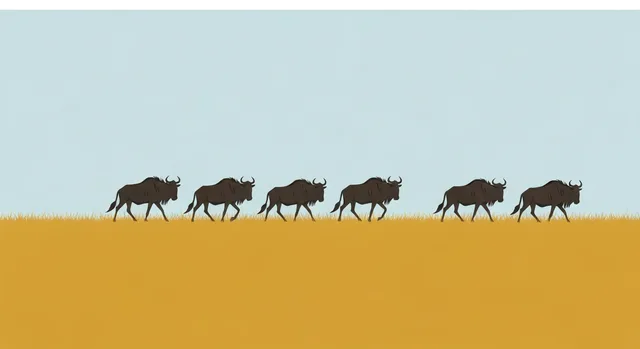
The Great Migration is a year-round clockwise loop through the Serengeti–Mara ecosystem, and the Northern Serengeti is where its most dramatic chapter unfolds. After calving in the south and the first water test on the Grumeti in the west, the herds push north through the dry season until they meet the Mara River. There, against the Kenyan border, the migration becomes the spectacle the whole world pictures: columns of wildebeest pouring across crocodile-dark water in a churning, desperate rush.
What makes the north distinctive is that the herds do not simply cross once and move on. They shuttle back and forth across the Mara through the season, drawn by grazing on either bank and the shifting rains, crossing and re-crossing between the Serengeti and the Maasai Mara across the border. That means there is no single crossing day to catch — there is a window of weeks in which the river drama repeats, unpredictably, and your job as a visitor is to be present and patient within it.
At a glance
A quick read on the northern migration before the detail. Keep park-fee and camp figures to official sources and your operator — they change, and this page stays evergreen.
- Stage: the Mara River crossings, in the far north against the Kenyan border.
- Timing (30-year average): roughly July to October, peaking around August — verify for your exact dates.
- Key bases: Kogatende, south of the river, and the Lamai Wedge, north of it.
- Strategy: several nights close to the river, a patient guide, and a flexible mindset.
- Reality: crossings cannot be guaranteed; the building tension and resident wildlife are the sure rewards.
- Booking: scarce beds in peak season sell out a year or more ahead.
When the herds reach the Mara
In a typical year the leading edge of the migration reaches the Mara River from about July. Crossings usually build through that month, peak around August, and continue into September and often October before the short rains begin to draw the herds back south toward the central and southern Serengeti. That dry-season window is the north's migration season, and it is the inverse of the southern calving calendar: when Ndutu is busy with newborns early in the year, the north is quiet; when the north thunders in the dry months, the south has emptied.
The crucial caveat is that all of this is a long-term average and not a schedule. The migration follows the rain, and an early or late season can shift the herds' arrival and the crossing peak by a couple of weeks in either direction. Come too early — May or June — and the herds are usually still south and west; come too late — November onward — and they have generally moved on. Verify the herds' likely position for your exact dates with your operator close to travel, and build a little flexibility into your nights if you can.
- July: leading edge arrives; first crossings in most years.
- August: usual peak of crossing drama and peak demand.
- September–October: crossings continue as herds shuttle across the border.
- Always verify: timing swings by weeks with the rains.
Mara River strategy
Watching a crossing is part planning, part patience and part luck — and the planning is the part you control. The first principle is proximity: base yourself as close to the river as your chosen camp allows, on the side the herds are expected to favour for your dates. Crossings can come at any hour, and the herds rarely wait for a vehicle to drive an hour from a distant lodge. The closer your camp, the more crossings you can realistically reach within a morning or afternoon drive.
The second principle is time. Three or more nights in the north dramatically improves your odds over a single rushed day, because crossings are episodic — a river may sit quiet for a day and then erupt the next. The third is a good guide. Crossing points shift from year to year as the banks erode, and an experienced northern guide reads the herds' mood, knows the current lines, and positions you with patience rather than chasing. The fourth is etiquette: keep back from the bank, stay quiet, switch off engines, and never put a vehicle between the herd and the water, because pressure can turn a herd back and ruin the moment for the animals and everyone watching.
- Stay close: a camp near the river beats a distant lodge every time.
- Stay long: several nights beat a single rushed visit.
- Trust the guide: local knowledge of current crossing points is decisive.
- Behave well: distance, quiet and patience protect the herds and the experience.
Why staying close matters most
If there is one lesson that separates a great northern crossing trip from a frustrating one, it is this: camp placement matters more than camp luxury. The most beautifully appointed lodge in the wrong spot — too far from the river, or on the wrong side of it for the season — will leave you driving long hours to reach the action and arriving after it. A simpler camp pitched within minutes of the likely crossing points will deliver you to the bank again and again while the window lasts.
This is why the north is the part of the Serengeti where verifying a camp's position against the migration for your exact dates matters above all. Many of the best-placed options are mobile or seasonal camps that set up near the river for the crossing season precisely so they can sit close to the herds, then pack down when the wildebeest move on. Confirm with your operator where your camp will be relative to the expected crossing zones during your nights — and book early, because the well-placed camps in peak season are among the first to sell out anywhere in Tanzania.
Managing expectations
It is worth saying plainly: no honest operator can guarantee you a crossing, and anyone who does is overselling. The herds cross on their own collective nerve, triggered by something no human fully reads, and a river can stay quiet through an entire visit even in peak season. The travellers who come away happiest are those who arrive with patience, treat the building tension on the bank as a spectacle in its own right, and regard a full crossing as a hoped-for bonus rather than a promised event.
And the north gives plenty even when the river stays calm. The scenery is among the most beautiful in the Serengeti, the crowds are thin, and the resident wildlife — lions, leopards in the riverine thickets, cheetahs on the open ground, elephant and giraffe — is excellent year-round. Come for the migration, plan well, stay close and stay long, but come ready to be rewarded by the whole experience of this remote, rolling corner of the plains.
Building an itinerary around the northern migration
A northern crossing leg works best when the rest of the trip is built to deliver you to the river at the right time. The classic sequence pairs a few nights in central Seronera for resident big cats earlier in the journey with a flight north to a camp near the Mara for the crossings — giving you the Serengeti's two great faces in one trip. On the way in from Arusha, the Ngorongoro Crater and Tarangire add a different landscape and break up the journey, and many travellers finish on the beaches of Zanzibar to decompress after the intensity of the river.
The non-negotiable is timing. Because the northern migration is a dry-season event, the whole itinerary has to be sequenced to put you at the river within the July-to-October window, ideally for several nights. Build the route backward from that: fix your northern nights first, then arrange the rest of the trip around them. And verify the herds' likely position for your exact dates close to travel, since a fortnight's swing can change which camp is best placed. Plan the north as the centrepiece it is, and let the supporting parks fall into place around it.
The crossing itself, moment by moment
It helps to know what you are actually waiting for. A crossing rarely begins on a schedule you can read; instead, the herds build along the bank over hours, sometimes days, milling and grunting, edging toward the water and pulling back. The tension is palpable — thousands of animals weighing instinct against fear, the river hiding crocodiles that have waited months for this. Then something tips: a brave individual commits, the column follows, and the river erupts into a churning, dust-and-spray chaos of bodies, hooves and current.
What follows can last minutes or much longer. Some animals are taken by crocodiles or drown in the crush; most make it across and gather, dripping, on the far bank, only for the herd to sometimes turn and recross days later. It is raw and it is not gentle, and part of planning for the north is arriving emotionally prepared for nature without a script. The reward is to have stood inside one of the last great wildlife spectacles on earth — a thing no documentary quite conveys, and that no operator can promise you on a given day.

Common questions about the northern migration
When does the migration reach the Northern Serengeti? Usually from July, peaking around August and continuing into September and October — but treat this as a 30-year average and verify for your exact dates.
Can a crossing be guaranteed? No. Crossings depend on weather, grazing and the herds' nerve, and cannot be scheduled. Several nights close to the river and a patient guide give you the best odds.
How many nights should I plan in the north? Three or more if you can. Crossings are episodic, and extra nights dramatically improve your chances while the scenery and resident wildlife reward you anyway.
Where should I base myself? Near the Mara River, around Kogatende or the Lamai Wedge, in a camp positioned for where the herds are expected on your dates.
Why does staying close matter so much? Crossings can come at any hour and rarely wait. A camp near the river reaches far more crossings than a distant lodge, whatever its luxury level.

Related guides

Northern Serengeti & Kogatende Guide
The complete guide to the Northern Serengeti — the Mara River, Kogatende, Lamai and the remote crossing country worth the flight. Dry-season migration timing, quieter game drives, where to stay, and how to plan a trip around the river.
Read guide
Kogatende: Gateway to the Mara Crossings
A guide to Kogatende — the airstrip, the camps and the Mara River access that make it the key base for crossing-season safaris in the Northern Serengeti. Why this is where most northern trips begin, and how to plan around it.
Read guide
Mara River Crossings in the Serengeti
How to plan a Northern Serengeti river-crossing safari without false promises — when the Mara crossings happen at Kogatende, why timing is luck, where to stay, and how to watch with good wildlife etiquette.
Read guideMore in Northern Serengeti
2
Lamai Serengeti Guide
A guide to the Lamai wedge in the far northern Serengeti — the triangle of rock-strewn hills between the Mara River and the Kenyan border, its remote crossing-season camps, and how to plan a trip to the quietest corner of the park.
Read guide
Lobo Serengeti Guide
A guide to the Lobo area of the northern-central Serengeti — its hills, woodlands and granite kopjes, the return-migration possibilities that make it a strategic October–November base, and how Lobo fits a northern itinerary.
Read guide